

globenewswire news
Kylo Peptides Expands Research Catalog to 36 Compounds as Peptide Science Enters a Record Growth Cycle
US research-peptide supplier scales its catalog against a market that analysts value between $47 billion and $141 billion, as peptides hold near 10% of new FDA drug approvals and GLP-1 use among American adults doubles in 18 months.
Sheridan, Wyoming, Aug. 10, 2026 (GLOBE NEWSWIRE) -- Kylo Peptides, a US supplier of research-grade peptides, has expanded its catalog to around 36 peptides and research blends, the company announced today. The milestone lands during the most active growth period in the history of peptide science, a field now valued in the tens of billions of dollars and drawing record scientific and clinical investment.
Peptides and oligonucleotides together accounted for close to 10% of all new drugs approved by the U.S. Food and Drug Administration in both 2024 and 2025 (Molecules, MDPI, 2025). Over the same period, demand for the best-known peptide class, GLP-1 receptor agonists, has surged. The share of US adults currently taking a GLP-1 roughly doubled between mid-2024 and late 2025 (KFF, 2025). That momentum has intensified interest in peptides as research materials.
“Peptides have moved from a specialty corner of the lab to the center of modern drug research, and the demand for well-characterized research material has grown with it,” said Dr Jamie Miller, QC Analyst at Kylo Peptides. “Expanding our catalog is a response to what researchers are repeatedly asking for, and we’ve grown it without changing how every batch is verified.”
Analysts Value the Peptide Market Between $47 Billion and $141 Billion
The global peptide therapeutics market is large and expanding, though estimates vary widely by how each research firm defines it. For 2025, Future Market Insights placed the market near $46.6 billion, Precedence Research at $52.6 billion, Roots Analysis at $90.2 billion, and Grand View Research at $140.9 billion. The gap comes largely from whether a given report counts high-volume insulins and GLP-1 drugs as peptides.
The firms agree on direction if not on scale. Grand View projects growth to $294.6 billion by 2033 at an 8.7% compound annual rate; Roots Analysis projects $233.6 billion by 2035; and most estimates cluster on a high-single-digit to low-double-digit annual growth track. North America holds the largest regional share, which Grand View places at roughly 62% of 2025 value.
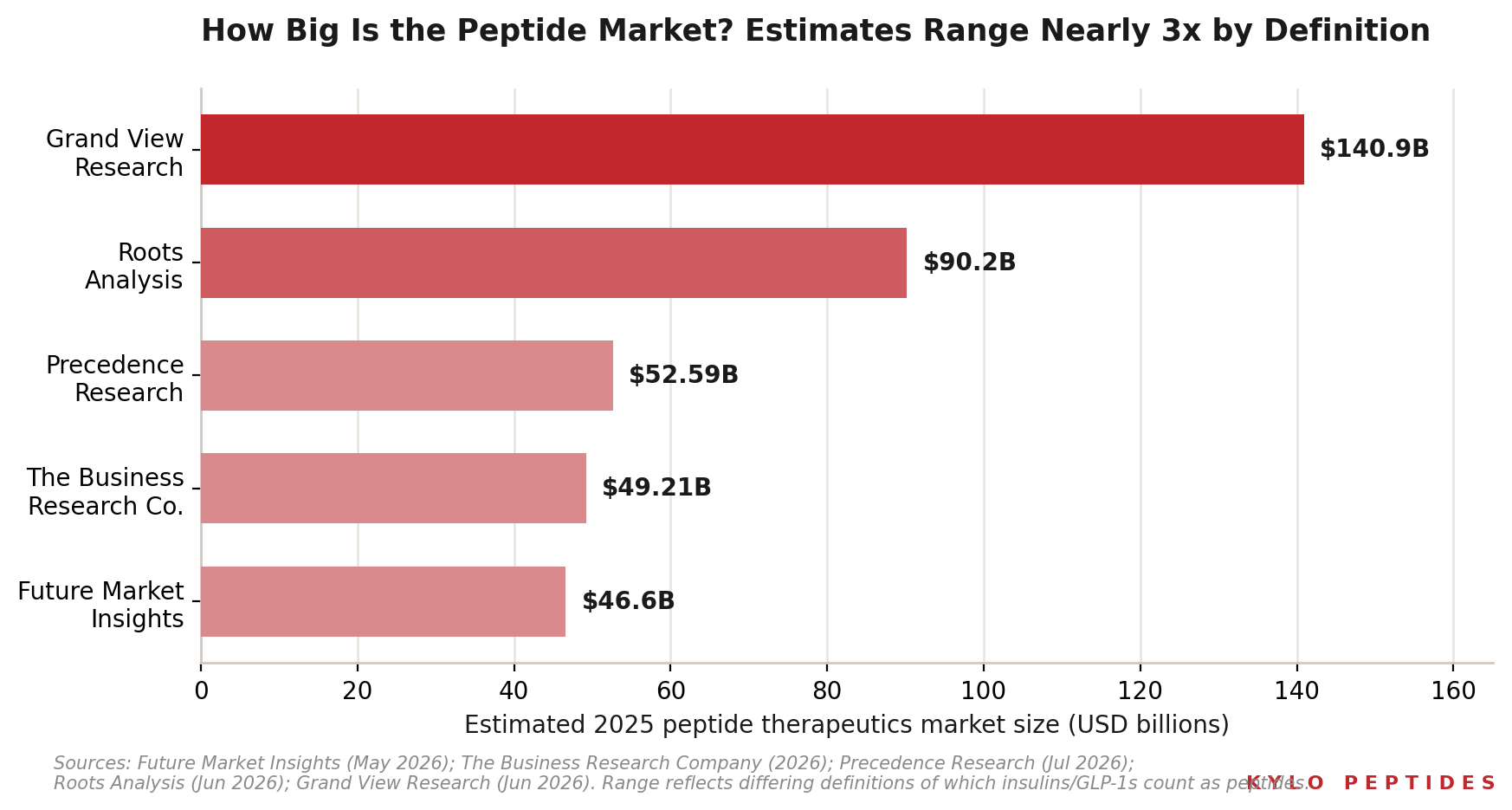
Sources: Future Market Insights, The Business Research Company, Precedence Research, Roots Analysis, Grand View Research (2026 reports). Figures are 2025 market-size estimates.
As the market expands, so does the range of suppliers serving it, and the standards they hold themselves to vary considerably. For laboratories, that makes sourcing a question of verification rather than availability. Research-grade peptide work depends on material that is correctly identified, pure, and consistent from batch to batch, and the strongest evidence of that is documentation that a researcher can independently verify. A few practices distinguish suppliers built around that standard:
- Independent, third-party testing- Verification by an accredited laboratory with no commercial stake in the result carries more weight than testing done solely in-house.
- Lot-matched certificates of analysis- A certificate should correspond to the specific batch in hand, identifiable by lot number, rather than a generic or representative document.
- A full analytical panel- Purity alone is one measure; identity confirmation, net peptide content, and contaminant screening such as endotoxin and heavy metals give a fuller picture.
- Verifiable provenance- Knowing where a compound was synthesized and tested, and being able to confirm it, matters as much as the headline numbers.
- Transparent documentation on request- Suppliers confident in their process make certificates and methods available rather than difficult to obtain.
Peptides Now Hold Close to 10% of New FDA Approvals
Peptides have become a durable part of the drug-approval landscape rather than a passing trend. According to peer-reviewed annual reviews of FDA approvals published in Pharmaceuticals and Molecules (MDPI), peptides and oligonucleotides, collectively termed TIDES, accounted for nearly 10% of all new drug approvals in both 2024 and 2025. From 2016 to 2024, the FDA approved 34 peptide drugs.
The pipeline behind those approvals is deep. A 2025 review in Signal Transduction and Targeted Therapy (Nature) documents hundreds of peptide candidates in clinical and preclinical development, with cancer research now rivaling metabolic disease as the leading focus area.
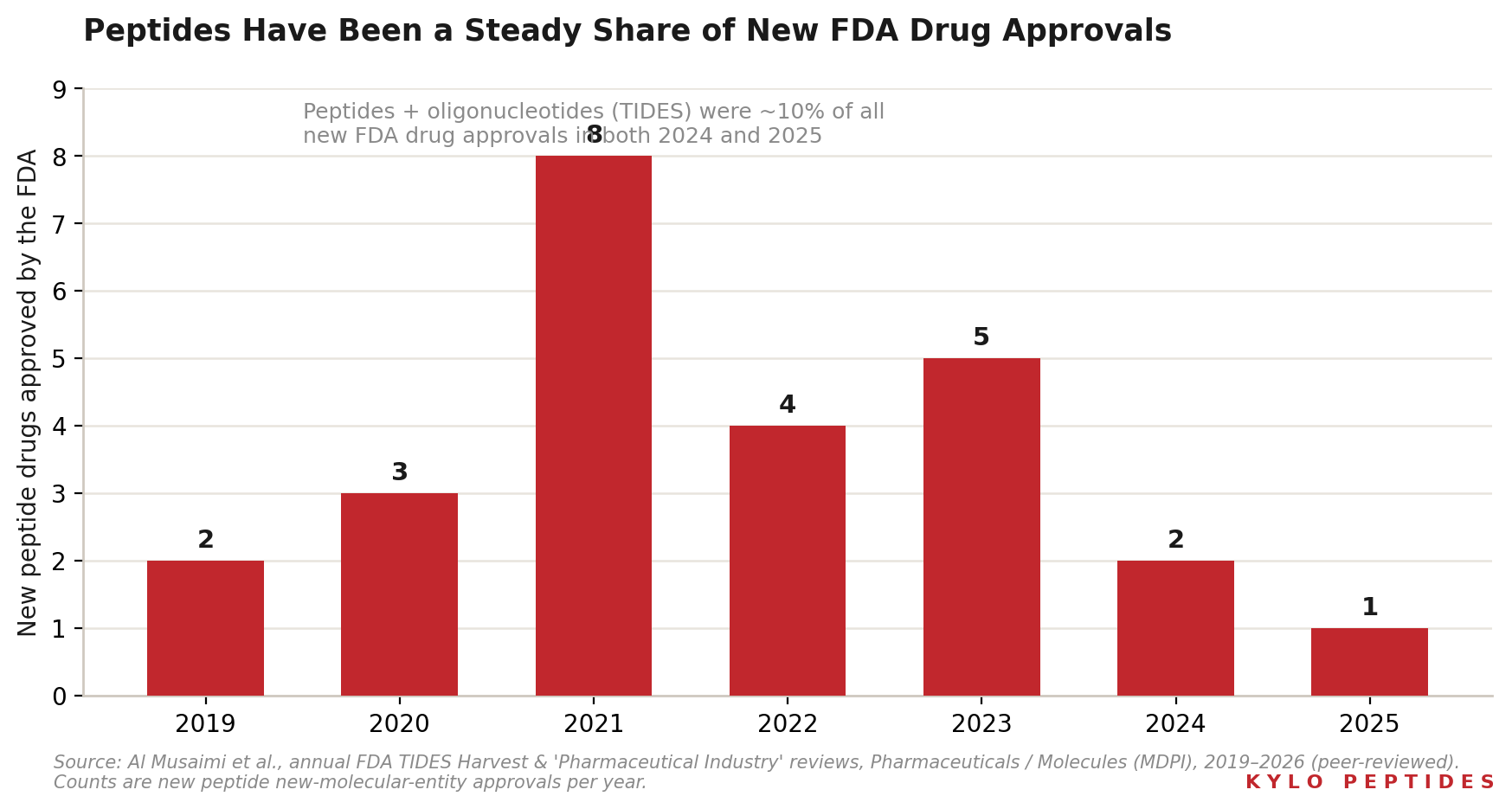
Source: Al Musaimi et al., annual FDA TIDES Harvest and Pharmaceutical Industry reviews, Pharmaceuticals / Molecules (MDPI), 2019–2026, peer-reviewed. Counts are new peptide drug approvals per year.
The GLP-1 Surge Is Reshaping Demand
No single factor has driven interest in peptides more than the rise of GLP-1 receptor agonists. Per KFF tracking polls, the share of US adults currently taking a GLP-1 rose from 6% in May 2024 to 12% by late 2025. In Medicare alone, GLP-1 claims climbed from 4.8 million in 2019 to 21.8 million in 2024, with gross Part D spending reaching $27.5 billion (KFF, 2026).
Among adults with diagnosed diabetes, 26.5% used a GLP-1 injectable in 2024, according to the CDC's National Center for Health Statistics. The commercial success of this one class has, in turn, accelerated research investment across the wider peptide field.
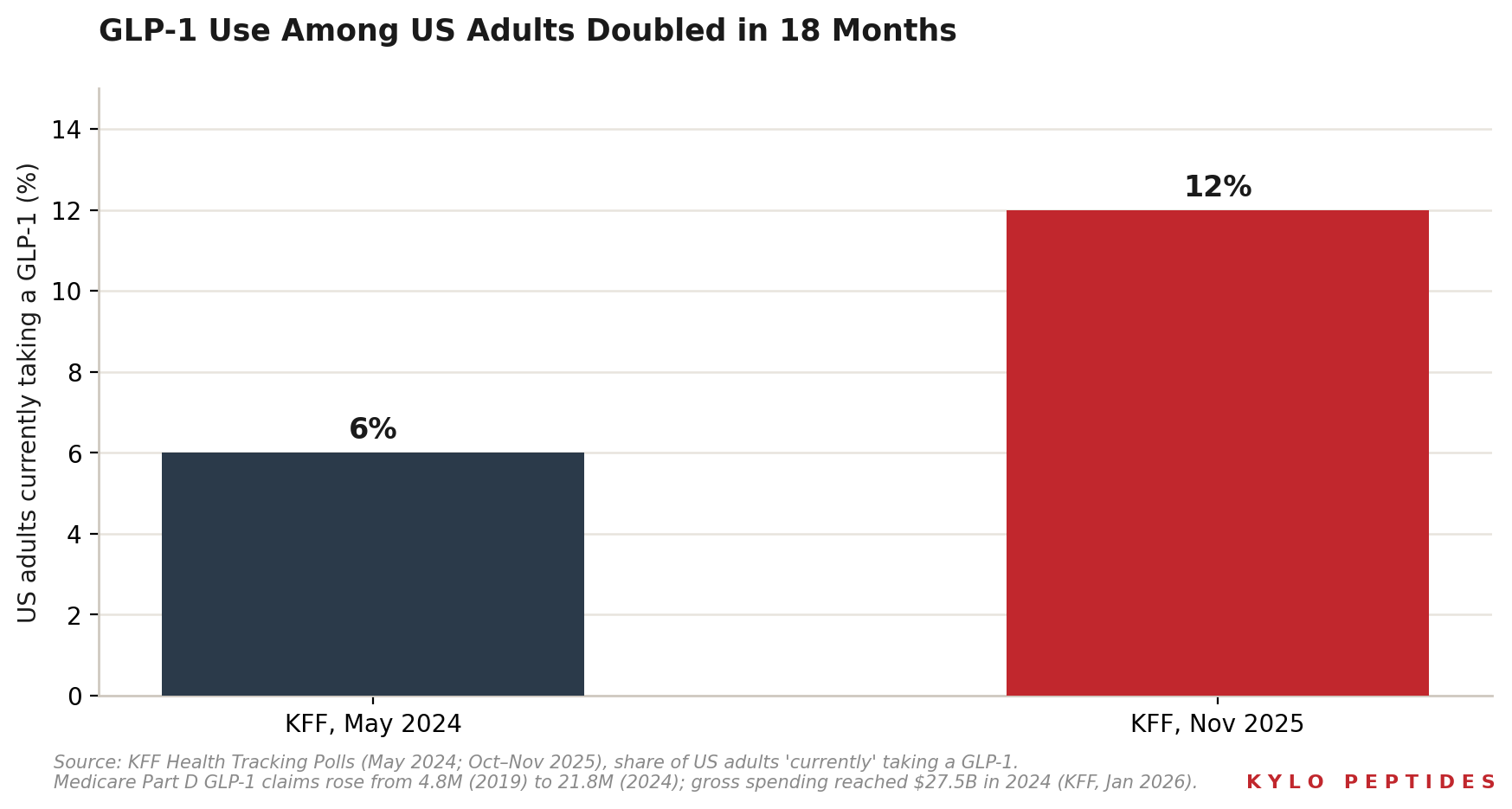
Source: KFF Health Tracking Polls (May 2024; Oct–Nov 2025). Share of US adults currently taking a GLP-1 medication.
Why Research-Grade Peptides Supply Is Crucial Now
Behind every approved peptide drug sits years of preclinical and in vitro research that depends on well-characterized peptide material. Advances in solid-phase peptide synthesis have made it possible to produce complex sequences at high purity and reproducibility, a shift documented across recent peer-reviewed reviews in the Journal of Peptide Science and elsewhere. As the number of peptide research programs grows, so does the need for consistent, verifiable supply.
Kylo Peptides synthesizes and lyophilizes its compounds in the United States and verifies every batch through three separate checks, an in-house panel followed by two independent laboratories, before release. Each batch is screened for identity, purity, and contaminants including endotoxin and heavy metals, with a lot-matched certificate of analysis published for every product.
“Growth in this field is only truly possible if the material underneath it is dependable,” said Dr Miller. “Our priority as we expand is that the last compound in the catalog is verified exactly the way the first one was.”
About Kylo Peptides
Kylo Peptides (Kylo Labs LLC) is a US supplier of research-grade peptides for in vitro laboratory research. Every batch is tested in the company’s own laboratory and then verified by independent third-party laboratories, such as Freedom Diagnostics, with a lot-matched certificate of analysis published for each product. All products are supplied strictly for laboratory and research use only, and are not intended for human or veterinary use.
Disclaimer
For Research Use Only. Not for human or veterinary use. The statements in this release have not been evaluated by the U.S. Food and Drug Administration. Any products referenced are supplied strictly for research, laboratory, or analytical purposes, and are not intended to diagnose, treat, cure, or prevent any disease.
CONTACT: Kylo Peptides (Kylo Labs LLC)
30 N Gould St, Ste R, Sheridan, WY 82801
research@kylopeptides.com
kylopeptides.com
Phone: +1 350-252-3314
