

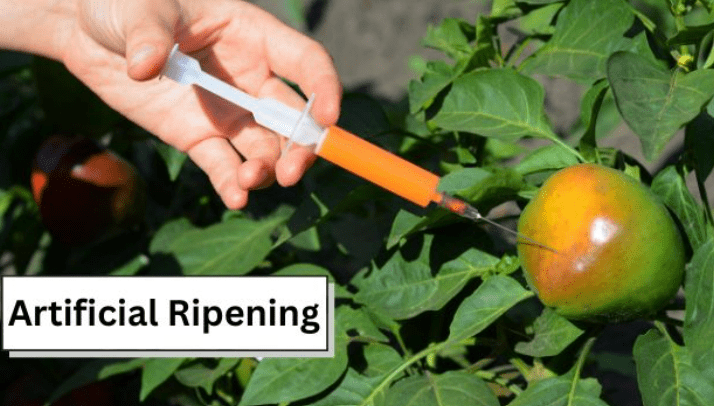
The Curious Case of Chemical Ripening: Why Fruits on the Shelf May Be Hiding a Hazard
The country’s food safety regulator, the Food Safety and Standards Authority of India (FSSAI), has issued a sharp warning and ramped-up inspections across States and Union Territories in light of increasing misuse of banned and unsafe chemical agents for fruit ripening and synthetic coatings. The directive — issued on 20 May 2025 — is prompting nationwide action in wholesale fruit markets, storage facilities, and retail mandis.
The key concerns
The focus is particularly on two damaging practices:
- The use of the banned chemical Calcium carbide (commonly called “masala” in fruit-ripening parlance) which releases acetylene gas and contains traces of arsenic and phosphorus that can remain on fruit and pose serious health hazards.
- The application of synthetic coatings, non-permitted waxes and artificial colours to fruits — to make them look more attractive, riper, fresher. The FSSAI notes that many fruit business operators (FBOs) may also be dipping fruits in chemical solutions such as an unapproved direct use of Ethephon for rapid ripening of bananas and other fruits.
What exactly is happening?
According to the directive:
- Inspectors will carry out special enforcement drives targeting storage facilities (go-downs), fruit ripening chambers and warehouses suspected of using illegal ripening agents.
- The mere presence of calcium carbide in the premises or stored near crates of fruits may be viewed as “circumstantial evidence” of a violation under the Food Safety and Standards (FSS) Act, 2006 — opening doors to prosecution.
- The use of calcium carbide for artificial ripening is explicitly banned under the Food Safety and Standards (Prohibition and Restrictions on Sales) Regulations, 2011. (Business Standard)
- FSSAI has also issued a guidance document titled “Artificial Ripening of Fruits – Ethylene Gas: A Safe Fruit Ripener”. In it, the recommended safe approach is to use ethylene gas under strictly defined Standard Operating Procedures (SOPs) via approved systems — rather than direct dipping of fruits into chemicals.
Why this matters
- Health risks: When calcium carbide is used, by-products like arsenic and phosphorus can remain on fruit surfaces or even penetrate peels, causing health issues such as mouth ulcers, gastrointestinal irritation, and even longer-term risks (some authorities warn of carcinogenic potential). (Indias News)
- Consumer trust and quality: Fruits artificially ripened may appear uniformly yellow, may not have developed full taste or internal ripening, and may spoil faster — meaning the consumer pays more but gets less quality. Officials note that dipping fruits in ethephon solution (outside SOP) can be hazardous and improper.
- Regulatory & trade implications: With regulators increasingly vigilant, violators face legal action, potential seizure of produce, and reputational risk. For legitimate growers and traders following safe practices, this directive underscores the value of compliance and transparency.
What traders and consumers should watch for
- For traders / FBOs: Ensure ripening chambers meet the SOP for ethylene gas use; avoid any use of banned substances like calcium carbide; keep storage and crates free of prohibited chemicals; maintain records of sourcing, treatments and compliance.
- For consumers: While authorities work to crack down, you can still be vigilant — look for fruits that have natural ripening characteristics (slight uneven colour, aroma, good texture rather than overly bright and uniform yellow), and buy from trusted vendors or supply chains that demonstrate transparency.
Looking ahead
The FSSAI’s renewed push suggests this issue is moving beyond occasional notices and toward structurally tougher enforcement. States are being told to integrate this into their food safety inspections, and it appears that summer fruits (mangoes, bananas, papayas) are under particular scrutiny given their high market demand and vulnerability to fast ripening shortcuts.
For the B2B side of fruit supply chains — wholesalers, ripeners, cold-storages — this means that the cost of non-compliance is rising, and the incentive for transparent, safe, approved ripening practices is becoming stronger. Consumers, meanwhile, have a growing reason to ask questions about how the fruit they buy is ripened, handled and brought to market.